
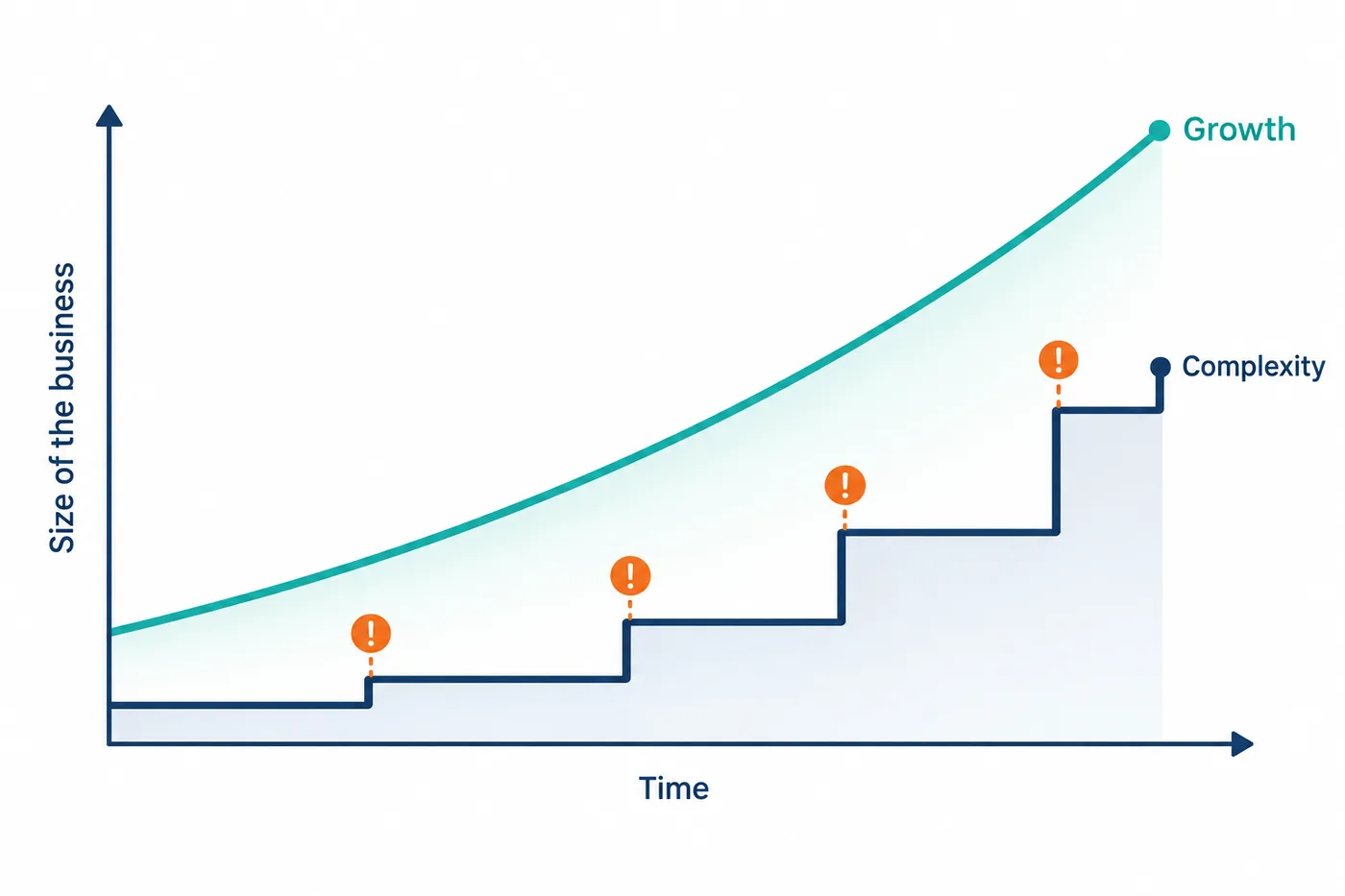
Most companies do not fail because they stop growing. They fail because they grow into a level of complexity they did not see coming. I have watched this happen often enough that I think it follows a pattern, and the pattern is worth describing.
The early days
When a company starts it usually has a few key people. Everyone is learning. They work out how to do things for a business of that size, and they get good at it. Complexity is at the lowest point it will ever be. There is nothing to coordinate, because the people who do the work are the same people who decide what the work is.
Then success starts. Orders come in, the client list grows, and for a while complexity stays manageable. The same few people stretch a bit further. They work longer hours, they hire one or two more hands, and the way they run things still works.
Growth is a slope, complexity is a step
This is the part that misleads people. Growth looks like a fairly smooth line going up. Complexity does not follow that line. It stays flat, and then it jumps.
The jump usually comes when the business needs another tier of management. Up to that point the founders could see everything. Now there are too many people, too many jobs and too many clients for anyone to hold it all in their head. Someone has to manage people instead of doing the work. Information has to move between people who used to just be in the same room.

Picture a small engineering workshop. Three people, one shop floor, and everyone knows what is on the bench. They land two large contracts in the same year and go from three people to twelve. Now there is a foreman, a buyer, somebody doing quotes, and the owner is no longer at the machine. Nothing about the actual work got harder. The running of it got far harder, and it did so in a matter of months.
The danger point
Not planned for
Planned for
GrowthComplexityComplexity jumps
That is the danger point. The complexity of running things causes mistakes. Deliveries slip, quotes go out wrong, cash is tied up in stock nobody tracked. Costs go up because of the new people and the new overheads, and the mistakes eat into the margin at the same time. Growth stalls, and often it crashes.
What decides whether the company survives is the gap. There is a moment when complexity spikes and there is a moment when the business adjusts to it. If that gap is short, the company takes a knock and carries on. If the gap is long, the costs keep climbing while the income does not, and the company can close. I have seen businesses that were doing well on paper fail at exactly this point, because nobody had planned for it.
If they do adjust, the cycle starts over. Growth picks up again, complexity stays manageable for a while, and then the next spike comes.
When the founders' roles have to change
Each spike is harder than the last. At the first one the founders can usually learn a new role and carry on. At the next one they often cannot. The jobs the business now needs are not the jobs the founders are good at, or want to do. Roles have to change, or be handed to other people. Taken far enough, the people who created the company end up handing the running of it to an outside CEO. That is not failure. It is what the shape of the business demands.
You can see it coming

The trick is to hang on through the spike and to plan for it before it arrives. This is more possible than it sounds, because complexity spikes are not random. They line up with what your clients are going to need from you next. If you know what your clients are likely to ask for next year, you know roughly when the next jump is coming.
The problem is that planning needs a clear mind, low stress and time to think. That is exactly what founders in a growing business do not have. They are in the work all day. So the planning does not happen, and the spike arrives as a surprise.
The questions themselves are simple. If we get X orders next quarter, could we cope? Who would do the quoting, who would chase the payments, who would manage the extra staff? If we lose client Y, could we cope? What would we cut, and how quickly? Running these possible futures through your head while things are calm is most of the job.
I think planning for growth is almost as important as planning for hard times, and it gets far less attention. Everyone has a story about preparing for a downturn. Very few people prepare for the big order they were hoping for, and that order is often what tips them over.
Where it ends
There is an end to this. If a company keeps adjusting through enough cycles, complexity eventually saturates. The business becomes so large and so structured that it cannot get more complex, even with more growth. The management layers exist, the roles are filled, the systems are in place. Scalability reaches a ceiling, and from there growth is just more of the same. Very few small South African companies get that far, but it is the shape of the road.
What I would take from all this is simple. Watch complexity, not just turnover. Expect the spikes, know what triggers them, and give yourself the headspace to plan. A system that keeps the day-to-day running of the business simple is part of that, and it is one of the reasons I built Vali the way I did. But the main thing is to think ahead while you still can.