
The short answer
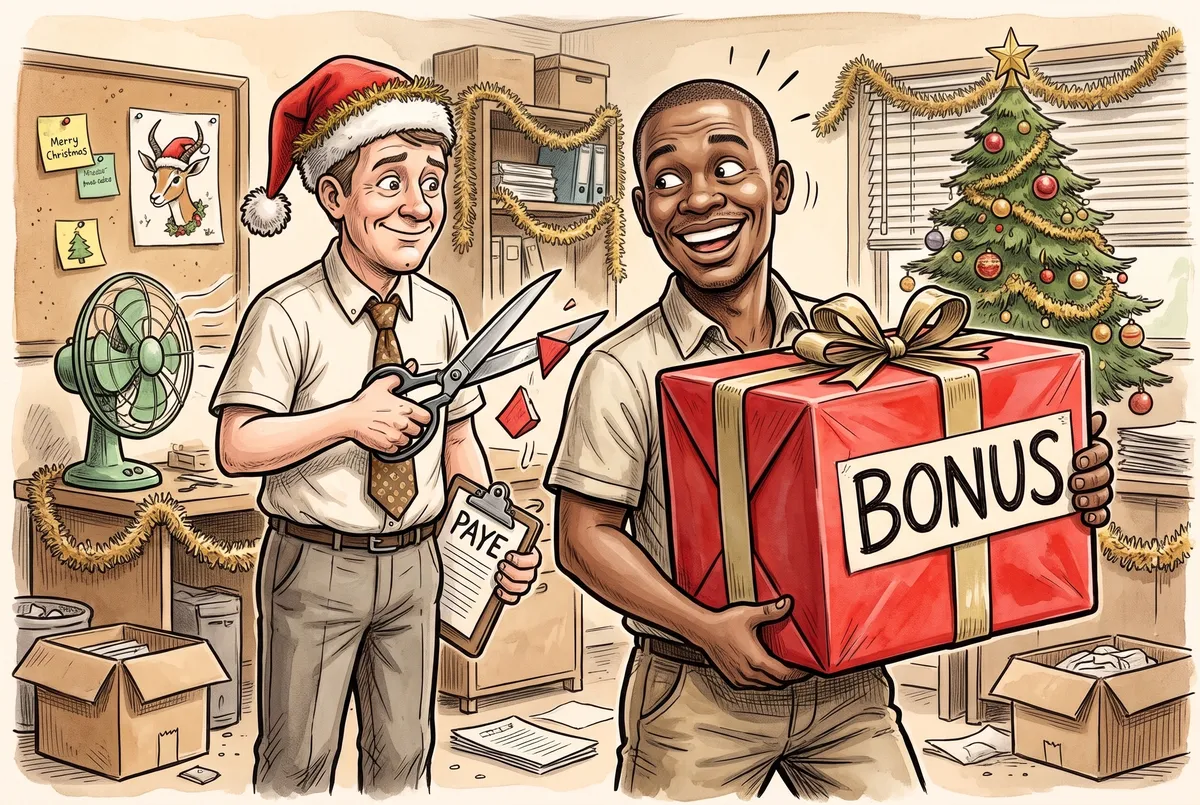
No. There is no special tax on a bonus. Your bonus is taxed as extra income for the year, so all of it is taxed at your highest tax rate. That is why the PAYE on it looks big. Over the whole tax year you normally pay the same tax as you would if the bonus had been spread over your salary.
In December many South African staff get a 13th cheque or a year-end bonus. Then they look at the payslip and the PAYE line is much bigger than usual. It looks as if SARS has a special bonus tax.
It doesn't. But the way PAYE is worked out on a bonus does take a bigger share of the bonus than of a normal month's salary. Here is why, with real numbers from the 2026/27 tax tables.
Why the bonus looks taxed more
South African income tax goes up in steps (brackets). The more you earn in the year, the higher the rate on the next rand.
Each month, your employer works out PAYE as if your normal salary carries on for the whole year. Your normal pay fills the lower steps first.
A bonus is added on top of that year's salary. So the whole bonus lands on your top step. You pay your highest rate on every rand of it, while a normal month is spread across all the steps and is taxed at a lower average rate.
How SARS works out PAYE on a bonus
SARS calls a bonus an "annual payment". Its guide for employers sets out the method:
- Work out your normal pay for a full year (the "annual equivalent").
- Work out the tax on that year's pay.
- Work out the tax on that year's pay plus the bonus.
- The PAYE on the bonus is the difference between the two.
Your employer can take all of it in the month the bonus is paid. Or, if it spreads the bonus tax over the rest of the year, it must still work out the tax at the start of your tax year and divide it over the pay periods left.
On your IRP5 the bonus shows separately from your salary, under code 3605, "Annual payment".
A worked example on 2026/27 figures
Thandi is under 65. She earns R25 000 a month and gets a R25 000 bonus in December. She has no other income, no medical aid and no retirement fund. The 2026/27 tax year runs from 1 March 2026 to 28 February 2027.
| Step | Working | Result |
|---|---|---|
| Normal pay for a year | R25 000 × 12 | R300 000 |
| Tax on R300 000 | R44 118 + 26% of R54 900, less the R17 820 rebate | R40 572 |
| Monthly PAYE | R40 572 ÷ 12 | R3 381 |
| Tax on R325 000 (year plus bonus) | R44 118 + 26% of R79 900, less R17 820 | R47 072 |
| PAYE on the bonus | R47 072 − R40 572 | R6 500 |
Her whole bonus sits in the 26% bracket, so the bonus PAYE is simply 26% of R25 000.
What that looks like on her payslips
| Pay | PAYE | % of pay | |
|---|---|---|---|
| Normal month | R25 000 | R3 381 | 13.5% |
| Bonus on its own | R25 000 | R6 500 | 26.0% |
| December total | R50 000 | R9 881 | 19.8% |
The December total is her salary plus the bonus. So yes, the bonus lost 26% while a normal month loses 13.5%. That is the step effect, not a bonus tax.
SARS's printed monthly tax tables may round slightly differently from this formula, so a real payslip can be a few rand off.
Why you don't pay more over the year
When SARS assesses your tax after the year ends, it adds up everything you earned and applies the brackets and rebates once.
For Thandi: 12 months of R3 381 plus R6 500 on the bonus is R47 072. The tax on R325 000 for the year is also R47 072. They match. Overall she paid 14.5% of her year's income in tax.
So you don't normally get a refund just because of a bonus. You can still end up with a refund or an amount to pay for other reasons, such as a pay change during the year, other income, or medical aid and retirement fund deductions.
UIF and SDL on a bonus
UIF is 1% from the employee and 1% from the employer, worked on pay up to R17 712 a month. The most an employee pays is R177.12 a month. Thandi already earns more than R17 712, so her bonus adds no UIF in December.
SDL (the Skills Development Levy) is 1% paid by the employer only. SARS lists bonuses as part of the pay it is worked on, so the employer pays SDL on the bonus. An employer whose total payroll for the next 12 months will not go over R500 000 does not pay SDL.
Does the law say you must get a 13th cheque?
No law sets a minimum bonus. The Basic Conditions of Employment Act covers things like working hours, leave and notice, not bonuses.
A bonus becomes something your employer must pay when:
- it is in your employment contract, or
- it is in a collective or bargaining council agreement that covers your employer (some sector agreements include an annual bonus), or
- it has been paid regularly for years with nothing saying it is at the employer's discretion. Labour law writers say this may make it part of your conditions of employment, and that paying it to some staff but not others may be unfair.
In February 2026 the Labour Court in Cape Town found that a group of employees were entitled to their 13th cheque under their contracts, and that the employer could not stop paying it without their agreement. IOL reported the ruling.
If you are an employer thinking of changing or stopping a bonus, check your contracts and any bargaining council agreement first, and get advice.
Want to see your own numbers?
The free salary calculator shows take-home pay, PAYE and UIF on 2026/27 figures. The salary increase and bonus calculator shows what a bonus pays out after tax.
Sources
Checked on 18 November 2026. A guide only, not tax or legal advice.
- SARS, Rates of tax for individuals (2027 tax year brackets, rebates and thresholds)
- SARS, Guide for employers in respect of employees' tax (2027) (annual payments and how PAYE on a bonus is worked out)
- SARS, Guide for employers in respect of tax deduction tables
- SARS, Guide for codes applicable to employees tax certificates 2027 (code 3605)
- SARS, What is the UIF?
- SARS, Skills Development Levy
- South African Government, Basic Conditions of Employment Act
- IOL, Labour Court affirms employees' rights: no unilateral withdrawal of 13th cheque, 18 February 2026
- Labour Guide, Is an employee on a fixed-term contract entitled to a 13th cheque?