
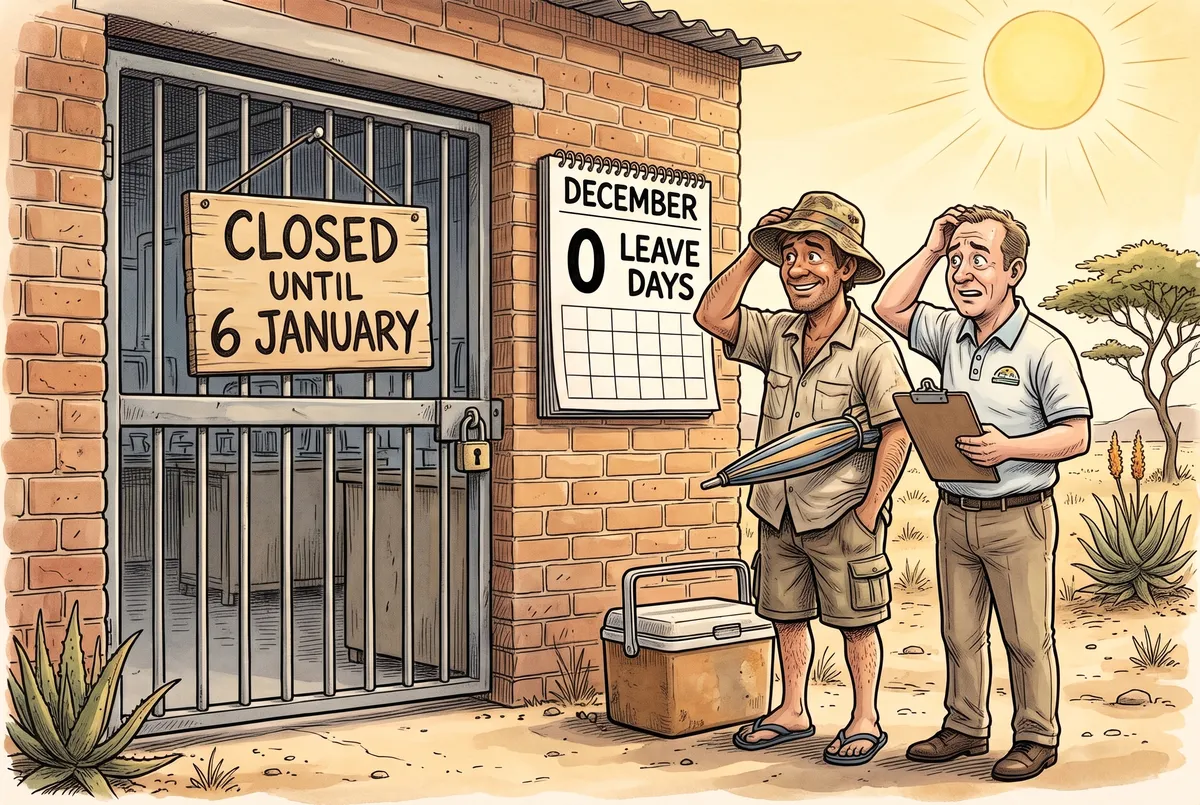
The short answer
Yes, an employer can make the December shutdown annual leave, if there is no other agreement. Public holidays inside the shutdown are not leave days. And the law says nothing about staff who don't have enough leave, so agree in writing what happens to them before the gates close.
Most South African factories, workshops and building firms close for two or three weeks over December. Every year the same questions come up. Can the business make staff use their leave for it? Do public holidays count? And what about the new person who has only built up a few days?
The answers sit in the Basic Conditions of Employment Act (the BCEA) and the Public Holidays Act. Here they are in plain words.
How much annual leave staff get
The BCEA gives at least 21 consecutive days of paid leave for every 12-month leave cycle with the same employer. By agreement it can instead be one day for every 17 days worked, or one hour for every 17 hours worked.
"21 consecutive days" is usually read as 15 working days for someone who works five days a week (18 for a six-day week). The Act itself only says 21 consecutive days.
A few more rules from the Act:
- The employer must let staff take the leave within six months after the leave cycle ends.
- Leave pay is at least what the person would have earned working, paid before the leave starts or on the normal pay day if agreed.
- These rules don't apply to someone who works fewer than 24 hours a month for the employer.
Can the employer make staff take leave over the shutdown?
Yes, when there is no agreement saying otherwise. Section 20(10) says leave is taken when the employer and employee agree, or, if they don't agree, at a time the employer decides. So a business can set the shutdown as annual leave time.
Two limits:
- The employer may not make or let staff work while they are on annual leave.
- Annual leave can't be forced on top of other leave the Act gives, such as sick leave, maternity leave or family responsibility leave, or during a notice period when someone is leaving.
Is there a notice period?
No. The Act doesn't say how far ahead staff must be told. Good practice is still to tell everyone the shutdown dates in writing, well ahead of time, to have the shutdown rule in the contract or leave policy, and to show each person how many leave days the shutdown uses and what they will have left.

Public holidays in this year's shutdown
These are the public holidays over the 2026 December shutdown:
| Holiday | Date | Day |
|---|---|---|
| Day of Reconciliation | 16 December 2026 | Wednesday |
| Christmas Day | 25 December 2026 | Friday |
| Day of Goodwill | 26 December 2026 | Saturday |
| New Year's Day | 1 January 2027 | Friday |
None of them falls on a Sunday this year, so no Monday holiday is added. (A holiday only moves to the Monday when it falls on a Sunday. There is no rule for Saturdays.)
A public holiday is not a leave day
Under section 20(8) of the BCEA, if a public holiday falls during someone's annual leave on a day they would normally work, the employer must give them an extra day of paid leave. In other words, the holiday is paid as a holiday, not taken off their leave.
For a five-day week, 16 December, 25 December and 1 January are all normal working days this year. So for a five-day worker, a shutdown that covers all three uses three fewer leave days than it has weekdays.
26 December is a Saturday. It only adds a leave day for staff who normally work on Saturdays.
Staff who don't have enough leave
This is the part that causes the most trouble, and the Act doesn't deal with it. It says nothing about "leave in advance" or what happens when someone has too few days to cover the shutdown.
In practice, businesses usually do one of two things:
- Unpaid leave for the days the person doesn't have, or
- Leave in advance: the employer gives the leave before it is earned, and the person builds it back up in the new year.
Leave in advance is common practice, not something the Act provides for. If you use it, be careful about one thing. If the person resigns before they have earned those days back, the employer can't simply deduct the money from the final pay. Section 34 of the BCEA only allows a deduction when the employee has agreed in writing to that specific debt (or a law, collective agreement, court order or arbitration award allows it).
What to do now: before the shutdown, agree in writing with each person who is short whether the missing days are unpaid or leave in advance. If it's leave in advance, get their written agreement that any days not yet earned may be deducted if they leave.
Can staff sell their leave instead?
Not the legal minimum. An employer may not pay someone instead of giving them their annual leave, except when the employment ends. On leaving, unused leave must be paid out.
Bargaining councils and sector rules
If your business falls under a bargaining council agreement or a sectoral determination, its rules on shutdowns and leave apply and can be different from the BCEA. The metal and engineering industry's Main Agreement, for example, has its own shutdown arrangements. Check your council's current agreement.
A short checklist
- Confirm the shutdown dates and tell staff in writing.
- Check whether a bargaining council agreement or sectoral determination covers your business.
- Count the leave days the shutdown uses, leaving out 16 December, 25 December and 1 January (and 26 December for Saturday workers).
- Check every person's leave balance against that number.
- For anyone who is short, agree in writing: unpaid days or leave in advance, with a signed agreement about deductions if they leave.
- Pay leave pay before the leave starts, or on the usual pay day if that is agreed.
Doing a stock take over the same weeks? See the year-end stock take checklist.
Sources
Checked on 18 November 2026. A guide only, not legal advice. For a dispute, get advice from a labour law adviser or your bargaining council.
- Basic Conditions of Employment Act 75 of 1997 (sections 18, 19, 20, 21, 34 and 40), and the government page for the Act
- Public Holidays Act 36 of 1994
- Department of Employment and Labour, Labour implications of the BCEA leave provision during the lockdown, 27 March 2020
- SEIFSA, Annual shutdown arrangements (metal and engineering industry)