

If you plan to take on people in the new year, December is the time to get ready. The workshop is quiet, you know what this year was like, and you can think about the role before applications start coming in.
Hiring well is mostly about doing the same simple things for every applicant, and keeping a record of why you decided what you did. This is the checklist, in order, from writing down the role to the new person's first day.
Download the hiring checklist to printOne A4 page with tick boxes, to work through for each job
1. Plan the role before you advertise
Write down what the job is for. What work will this person do every week, and what will they own? If two people describe the job differently, applicants will too.
Split must-haves from nice-to-haves. A must-have is something the person cannot do the job without: a code 10 licence for a driver, being able to lift 25 kg for a packer. Keep that list short. Everything else is a nice-to-have, and it helps you choose between good applicants, not rule people out.
Check the pay. The national minimum wage is R30.23 an hour from 1 March 2026. The 2027 figure has not been announced yet, so check it before you make an offer that runs past March.
2. Write an advert that says it plainly
Use the job title people search for, not your internal one. "Warehouse packer" finds more people than "Fulfilment associate".
Put the must-haves in the advert. Then applicants can see for themselves whether they qualify, and you get fewer applications you have to turn down.
Say what you will do with their information. The Protection of Personal Information Act (POPIA, section 18) says that when you collect someone's information you must tell them what you collect, why, and who you are. One or two lines at the bottom of the advert or the application form covers it.
Give a closing date, and stick to it.
3. Ask fair questions
The Employment Equity Act (section 6) says no one may unfairly discriminate against an employee on grounds such as race, gender, pregnancy, marital status, family responsibility, age, disability, religion, HIV status, culture, language or any other arbitrary ground. Section 9 says job applicants count as employees for this. So this applies to every advert, form and interview, whatever the size of your business.
If you do not need the answer to decide, do not ask the question. Questions like "Are you planning to have children?", "How old are you?" or "Which church do you go to?" have no place in an interview. The only exception is an inherent requirement of the job (section 6(2)), and that is narrow.
Ask everyone the same questions about the work, and write down the answers. When you compare applicants later, you are comparing like with like, and you have a record of why you chose who you chose.
Medical tests only when the law allows them. Section 7 bans medical testing of employees and applicants unless a law requires it or it is justifiable, for example because of an inherent requirement of the job. HIV testing needs a Labour Court finding that it is justifiable.
Psychological tests must be valid, reliable and fair (section 8). Since 1 January 2025 they no longer need to be certified by the Health Professions Council, but they still have to meet those three tests.
Good to know: since 1 January 2025, employers with fewer than 50 employees are no longer "designated employers" under the Employment Equity Act, whatever their turnover. That takes away the Employment Equity plan and reports, but not the rules above.
4. Look after the CVs and answers
Do not keep applications forever. POPIA section 14 says records must not be kept longer than needed for their purpose. Decide how long you will keep unsuccessful applications, tell applicants, and delete them after that, unless an applicant asks you to keep them on file for future jobs.
Treat sensitive details with extra care. Health, criminal records, race and religion are "special personal information" under POPIA (section 26). Only ask for them when you have a good legal reason, such as the applicant's consent or a legal duty, and keep them away from people who do not need to see them.
5. Check before you offer
Ask before you phone references. Tell the applicant who you will contact, and only ask about the work.
Get consent for a criminal record check. A criminal record is special personal information, so get the applicant's written consent before you run a check, and only run one where the job calls for it.
Check the qualifications. Under the National Qualifications Framework Act (section 32B), claiming a qualification you do not have is a crime, with a fine, up to five years in prison, or both. The South African Qualifications Authority (SAQA) keeps registers of misrepresented and fraudulent qualifications. Ask to see the original certificate, and confirm it with the college or SAQA for any job where the qualification matters.
6. Make the offer in writing, and get day one right
Put the offer in writing. Start date, job title, pay, hours and probation. The person knows what they are accepting, and so do you.
Set the probation period up front, and keep it reasonable. The Code of Good Practice: Dismissal, which replaced the old Schedule 8 on 4 September 2025, says probation must be set in advance and be of a reasonable length. During probation you should give the person guidance and help to meet the standard. Before you extend probation or let someone go at the end of it, they must have a chance to respond.
Give the written particulars on the first day. The Basic Conditions of Employment Act (section 29) says that when an employee starts, you must give them written particulars of employment: who you are, the job, the place of work, the start date, hours, pay, deductions, leave and notice. Most businesses do this in the employment contract.
Register the new person. The Unemployment Insurance Act (section 56) says an employer must give the UIF the details of each employee: name, ID number and pay. If this is your first employee, SARS says you must register for PAYE within 21 business days of becoming an employer, unless no employee earns enough to pay tax.
Tell the people you did not choose. A short, polite message to every applicant who reached an interview. It costs a minute and it is how you keep a good name in a small town.
How we do it in Vali
We built Recruitment in Vali around this checklist.
- Post a job and share one link. Applicants apply on their phone, one question at a time, with their CV and consent, and get a private link to see where their application stands.
- Mark the must-haves and the passing answers, and see at a glance who meets them. Write your own questions, copy them from another job, or start from a ready-made set.
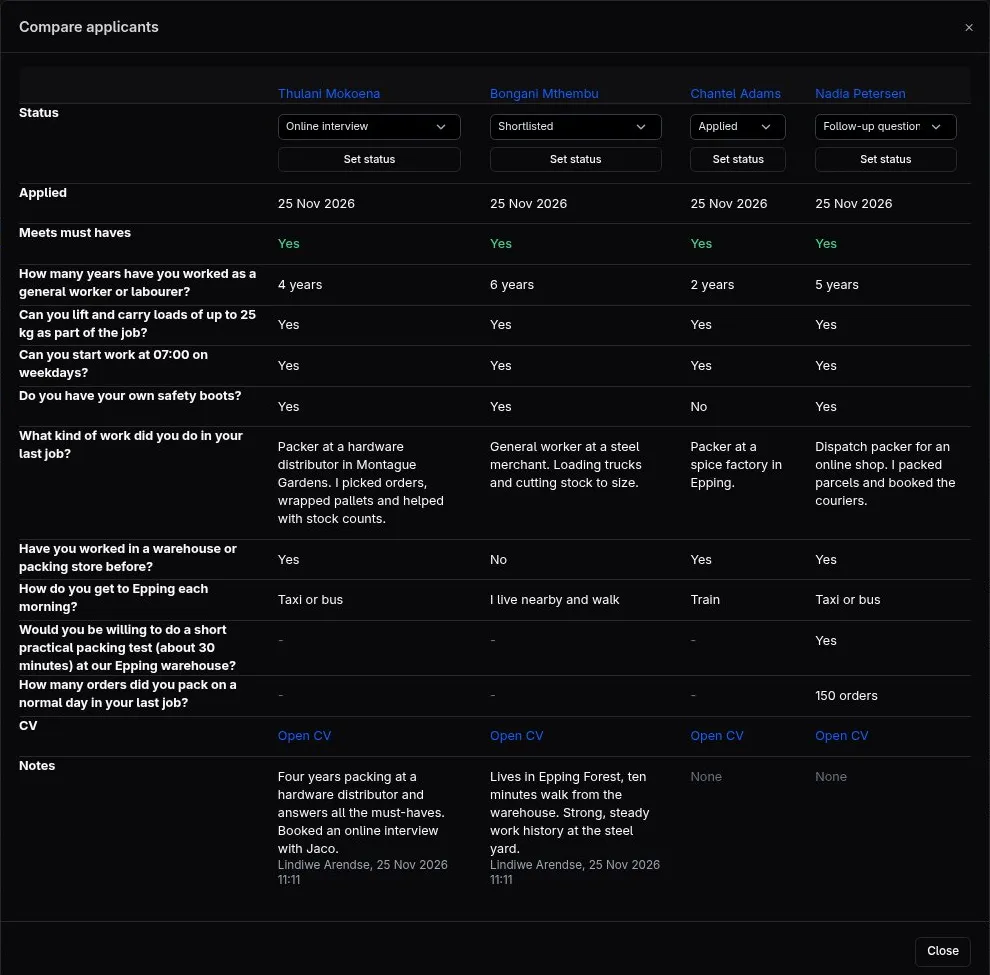
- Compare applicants side by side, keep team notes, send follow-up questions and book interviews with calendar invites.
- Send a signed offer, turn the person you hire into an employee in one click, and turn the rest down politely. Applications are deleted 12 months after the job closes, unless the applicant asks to be kept on file.
There are four short videos, from posting a job to hiring, on our videos page: watch the hiring videos
The checklist
Plan the role
- What the job is for, written down
- A short list of must-haves, the rest nice-to-haves
- Pay checked against the national minimum wage
Say it plainly
- The job title people search for
- Must-haves and a closing date in the advert
- What you will do with their information
Ask fair questions
- The same work questions for everyone, answers written down
- Nothing about age, pregnancy, family, religion or health unless the job truly needs it
- Medical or psychological tests only where the law allows
Look after their information
- How long you keep applications decided, and kept to
- Sensitive details only with a good reason, kept private
Check
- References, with the applicant's go-ahead
- Written consent before any criminal record check
- Original certificates seen and confirmed
Put it in writing
- Written offer with a set, reasonable probation
- Written particulars of employment on the first day
- UIF details sent, PAYE registered if this is your first employee
- Every interviewed applicant told the outcome
Download the hiring checklist to printOne A4 page with tick boxes, to work through for each job
This article is general information, not legal advice. The legal points were checked against the Acts and official notices on 25 November 2026. For a specific case, speak to a labour law adviser.